
Is Russia Preparing for an Expanded Ukraine War?
Russia has Surrounded a Ukrainian Satellite 547 km above the earth

Between May 14 and May 20 Russia repositioned five of six recently launched Cosmos military satellites (Cosmos 2610, 2611, 2612, 2613, 2614 ) from an orbital inclination of 97.0 degrees to 97.8 degrees, putting the Cosmos satellites on the same orbital plane as a satellite known as ICEYE-X36.
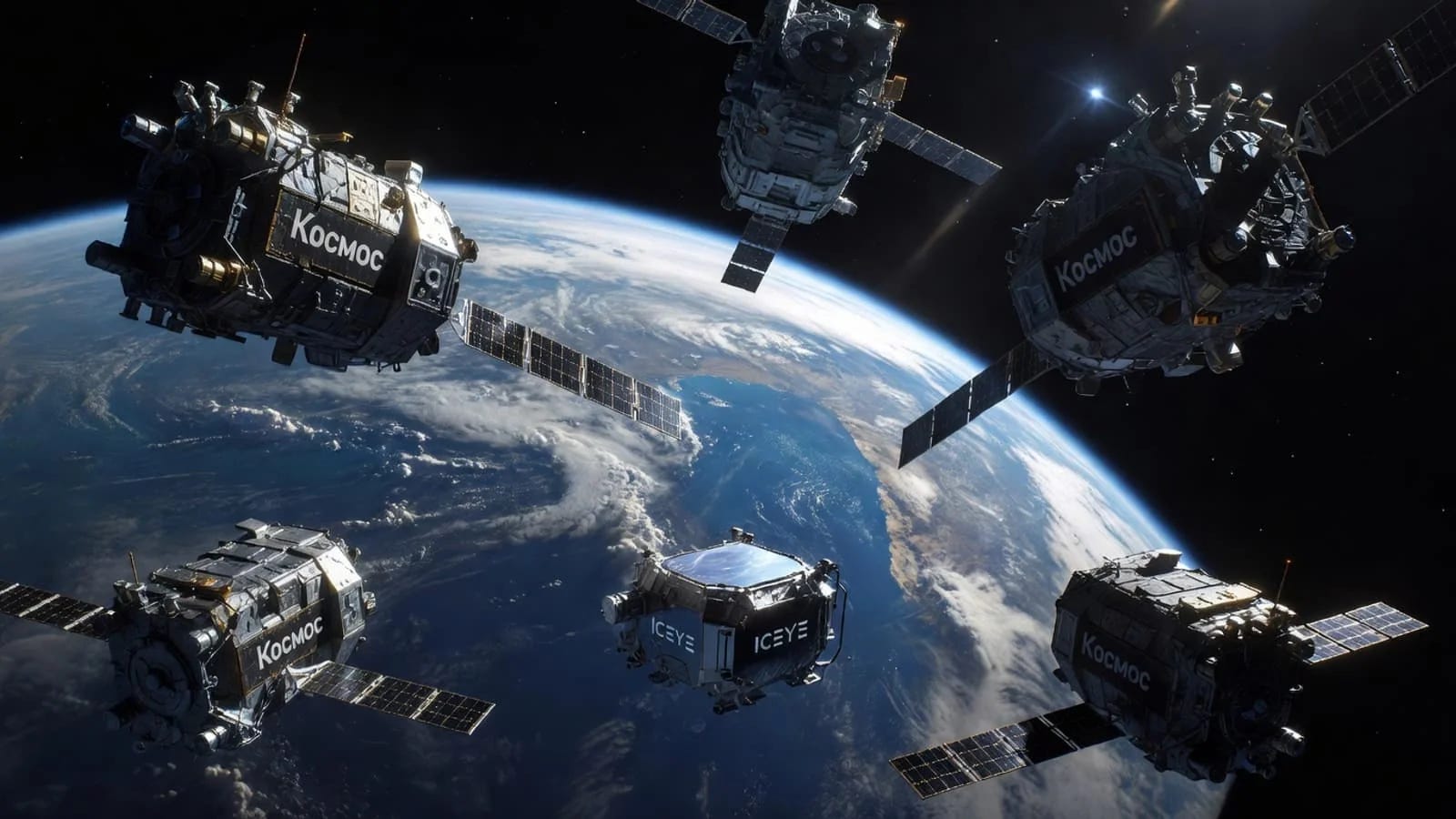
ICEYE is a Finnish-American aerospace and data company that designs, builds, and operates the world’s largest constellation of SAR satellites.
Repositioning five Cosmos satellites is an unprecedented move.
According to Integrity ISR, ICEYE-X36 was launched March 4, 2024 from Vandenberg on a SpaceX Falcon 9. It’s registered under ICEYE US, has a mass of ~90 kg and is one node in a 44+ satellite constellation that Ukraine can task. However, it is clearly the most important satellite for Ukraine.
According to reports, ICEYE-X36 has been a game changer for Ukraine. It is a synthetic aperture radar satellite (SAR) that has all but revolutionized the battlefield, enabling the identification of enemy equipment, tracking of troop movements, and being able to identify even camouflaged equipment and command and control assets under virtually any weather conditions. ICEYE-X36 has a ground resolution of 16 cm (6.3 inches), so even a footprint is visible from space.
ICEYE-X36 is owned by Ukraine, and Ukraine operates it with significant help from NATO and from NATO companies, helping Ukrainian analysts to sort out the received imagery. According to the most recent report, ICEYE-X36 has produced 4,100 images, located 238 air defense and signals intelligence units, successfully targeted 153 fuel depots, and 17 Russian naval bases.
This is a capability the Russians cannot match, although Russia has a SAR satellite of its own, but only one. The Russian satellite was launched in late December, 2025. It is called Obzur-R (”Survey”). It is not a microsatellite like ICEYE-X36. It was developed by Roscosmos and TsSKB-Progress and features a Kasatka-R X-band Synthetic Aperture Radar with a claimed resolution of 1 meter (almost 40 inches). It is supposed to operate from 5 to 8 years and Russia claims it will eventually produce three more Obzur-class SAR satellites. Obzur-R weighs between 3.5 and 4 tons (3,629 kg).

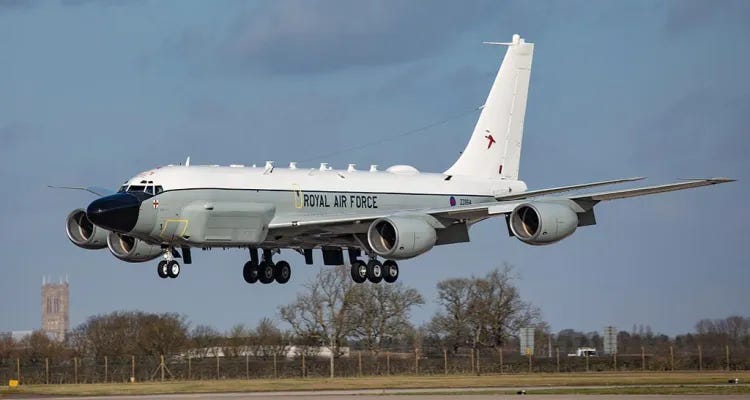
Russia has been tracking and occasionally challenging NATO surveillance space and aircraft systems, including manned aircraft and drones. The UK Ministry of Defense released information on May 20 about an encounter between a British surveillance platform (RC-135W Rivet Joint signals intelligence aircraft) and Su-35 Flanker-E and Su-27 Flanker Russian fighter jets over the Black Sea in mid-April. The Su-35 closed the distance to the Rivet Joint so aggressively that the wake turbulence or proximity sensors triggered the British aircraft’s onboard emergency defense systems, automatically disabling its autopilot. The Su-27 performed six separate close-range passes directly across the nose of the Rivet Joint. At its closest point, the Russian fighter cut within 6 meters (19 feet) of the unarmed reconnaissance plane. Rivet Joint intercepts and analyzes electronic signals to provide real-time battlefield intelligence.
Most experts believe that the Russian Cosmos satellites, now very close to ICEYE-X36, are likely positioned for what the trade calls a Rendezvous and Proximity Operation (RPO). Technically, the Russians could threaten ICEYE-X36 in a number of ways, ranging from actually destroying it, blanking out its solar panels that power the SAR system, to jamming the ICEYE radar using microwaves, lasers, or other methods. (Exactly why the Russians committed 5 Cosmos satellites to shadowing ICEYE-X36 is unclear.)
There have been intelligence reports that Russia may be planning a major offensive, perhaps even an invasion aimed at Kiev that could possibly involve Belarus. Such an offensive would emulate the invasion route that began on February 24, 2022, but would somehow be successful in taking Kiev.
Despite the reports, at present there is no hard evidence to support the claim, although the ICEYE-X36 encounter sounds as if it is preparatory to something big.
The Russians have been mostly bogged down for some time on the battlefield. Over the past year or longer, a key focus for Russia has been to force concessions from Ukraine by crushing its civilian infrastructure, especially power generation, transmission systems, and other critical infrastructure elements. To do this Russia has launched missiles and Shahed drones in large quantities. Yet despite destroying a significant part of the Ukrainian energy infrastructure, especially in the east, Ukraine has not been willing to actually negotiate with Russia and, in particular, offer any “land for peace” proposals. It seems fair to say that the Russian campaign failed to move the Ukrainian political needle in the direction of a deal, and in fact probably moved Ukraine to take a very hard line (sometimes frustrating Washington that has been anxious to broker a deal). In fact, bombing campaigns have generally failed to lead to settlements.
Meanwhile the Russian army has been stymied by the massive tactical drone capabilities Ukraine has used, and the increasing ability of Ukraine, with ICEYE-X36 and NATO operational and planning help, to cause serious damage in western Russia, including in Moscow and St. Petersburg.
Putin faces a significant dilemma because Russia’s strategy is failing. A palm reading of the Russian President’s hand suggests he faces a near existential challenge to his government’s survival, something that would not have been guessed a year ago. While Russia certainly has some tactical options to try and restore their army’s battlefield initiative, and a good size reserve force it can commit, the outcome is likely to be both bloody and uncertain. Blinding ICEYE-X36, should Russia decide to do it in the context of a large-scale military operation, is now on the table, but doing so probably won’t change the algebra of the war.
Putin government faces an existential challenge politically? Not sure where you’re getting that.
<snip> the massive tactical drone capabilities Ukraine has used, and the increasing ability of Ukraine, with ICEYE-X36 and NATO operational and planning help <snip>
Are you here admitting that NATO and its running dogs are actually in a state of war with Russia.... Is this what you are suggesting ?