
Trump Administration Weakens "Aggressive" Export Controls and Threatens National Security

Recent US export control decisions imperil national security and threaten not only US artificial intelligence "dominance" but potentially many other emerging technologies critical to military programs.
While legal US exports of AI-related semiconductors were blocked, China got at least $1 billion worth of Nvidia chips illegally, mostly in "packages" of data-center-ready racks. The packages being sold in China are labeled as Supermicro, Dell and Asus. The chip packages, that include software, were sold at a 50% markup over US prices. Meanwhile, the Financial Times reports that the Trump administration has decided to lift "aggressive" strategic export controls and has directed the Commerce Department's Bureau Industry and Security to implement the new directive.
Under the US export control system, commercial exports, also known as dual use exports, are controlled by the Department of Commerce. However, the Commerce Department is supposed to coordinate with the Department of State, Department of Defense, Department of Energy, Department of Homeland Security and US intelligence.
By law US export controls support national security, short supply and US foreign policy. These are broad categories. The US is also supposed to coordinate its export controls multilaterally, but since the dissolution of COCOM in 1994 and the weak substitute Wassenaar arrangement, very often the US resorts to unilateral export controls.
It is not clear what "aggressive" strategic export controls are, nor is it clear how it impacts the interagency deliberative process. One presumes that the Commerce Department's Bureau of Export Controls will try to come up with some sort of export licensing guidelines to cover the White House directive. Neither Commerce, nor the other involved agencies, apparently played any role in the White House directive.
Prior to the White House decision, the President previously told Nvidia it could restart chip exports to China, apparently a quid pro quo where China released rare earth exports to the United States.
Twenty former US officials say allowing Nvidia to export chips to China was a strategic misstep.
The latest White House move, lifting “aggressive” strategic export controls, is designed to facilitate trade negotiations between the US president and China's president, Xi Jinping. Looked at objectively, Chinese export restrictions trumped Trump (pun intended). Some expected that Trump would go to China in September when Russian President Vladimir Putin also is expected. However, it appears that idea has been nixed, and Trump won't meet with Xi and Putin together, and will come to China later in the Fall, probably after the APEC meeting in South Korea. News reports say that China and the US are working on an agenda and a date for a high level meeting.
The immediate impact on removing "aggressive" export controls impacts technology for artificial intelligence. The Trump administration has released an AI Action Plan. The Plan calls for removing "red tape" that delays AI investments and initiatives, investing more in AI, and boosting government investment, especially by the Defense Department. The Plan describes the US effort in AI as a "race" like the "space race" in the past and it seeks "American dominance" in AI.
The latest decisions on export controls, and specifically on Nvidia, compromise the Action Plan. They are totally incompatible.
The lifting of export controls on Nvidia, which is the premier component in AI-data centers, and the subsequent order lifting "aggressive" export controls not only subverts the billions of investment already made in AI, but leaves uncertain what other critical US technologies will be sold off.
There is little doubt China is aggressively pursuing AI and is investing billions in the effort. According to Morgan Stanley, China is a sleeping giant that is now awakened and is seeking global AI dominance by 2030. It is important to note that US companies like Nvidia, will directly assist China by sharing know-how and technology.
There are many sensitive emerging technologies that are quite important and in many cases national security sensitive. The chart below illustrates some of them:
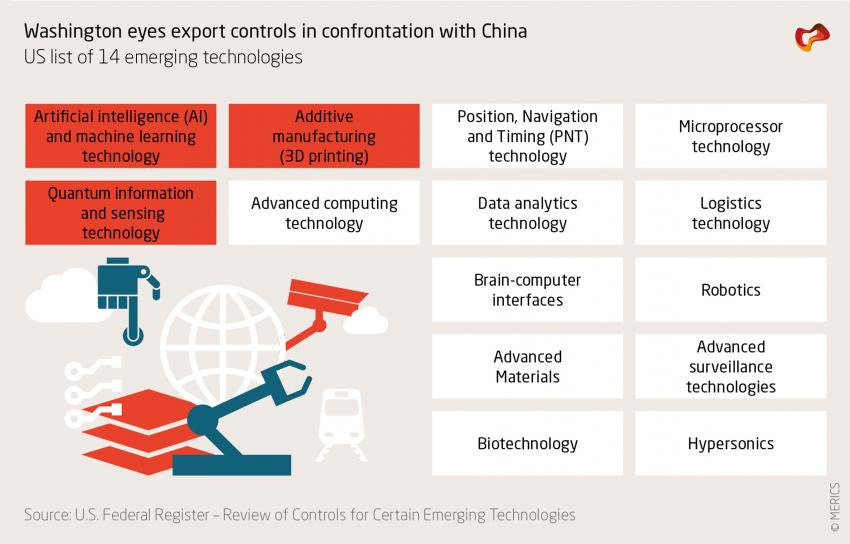
The immediate question is whether the latest policy guidance from the White House includes any or all of the emerging technologies? The above chart was published to highlight what the Trump administration originally wanted to curtail using export controls.
It is normal whenever new US export controls or guidance is proposed for the Commerce Department to publish the policy for comment before it is approved. In the comment period, the public (most often industry) comments on the proposed rule. It is far from clear if Commerce will publish guidance for the latest policy change, but it should do so. Moreover, the Commerce Department should explain the national security implications as it understands them.
There also is the question of interagency coordination, a non-trivial part of the US export control process. Will the Defense Department and other agencies (especially the intelligence community) be consulted, or will the Department of Commerce ignore the other agencies? Typically the Defense Department concerns itself with the impact of approving export licenses that might undermine national security and the military mission. Beyond that, many of the emerging technologies are critical to US defense systems, and represent areas where the Defense Department has invested billions of dollars.
The latest decisions contradict the Action Plan on AI and potentially compromise export control protection of critical emerging technologies. In turn the decisions damage US national security as defined, in part, by the administration itself.
Ho hum! What does AI matter when the US lacks the capability to make the high-end chips? They come from Taiwan, made on Dutch machines. And what good does AI do the US when China today is outbuilding the US in ships by a factor of over 100 (!)? How many US warplanes could take off if all the Chinese-made components were removed?
Yes, the US may have a temporary advantage in AI software. But look at China's production of STEM graduates versus the US's -- and note that a large share of "US" STEM graduates are in fact Chinese citizens. Today's US advantage in AI is a rapidly diminishing asset, regardless of what the US does to try to sustain it.
The US's problems are all internal, mostly caused by our government -- de-industrialization, inadequate educational system, excessive counter-productive regulations, Byzantine tax laws, too many lawyers throwing sand in the gears. Until we get all those problems sorted out (which would in the best case take at least a quarter of a century), we would be smart to try to be on friendly terms with China, our critical supplier.
Very early in the year the Editor of FP spoke of a private conversation he had with a senior Biden official around Christmas time last year. The conversation was about why the official thought that the Democrats had lost the election. At one stage the Editor asked first if the Trump One proscriptions on technology to China, which the Biden Administration had kept and strengthened, were actually working - to which the official replied that the evidence showed that the embargos had failed and China were overcoming their technological deficiencies with native innovations. As to why the Biden Administration had kept the Trump One embargos even as they had not worked, was down to local politics where the Biden Administration were trying to leach back some MAGA voters by being 'tough on China'. So anecdotally, the US embargoes on technology appear to be failing.
What is not spoken about in the article is Jensen Wong's argument to Trump - and which apparently has had some impact on Trump. Wong argues that Nvidia chips (of a certain type at least) should be sold to China. Not only does Nvidia make a killing in the largest chip market in the world, but that China has no need to develop local solutions independent of the US, and where China builds a dependency on the US for it's chips. The US is then in a position to dictate standards and use its chips as leverage in the future. But it is a catch-22 situation.
On one hand China might develop an addiction to Nvidia chips, stop local initiatives and fulfil Wong's vision. But Wong's reasoning may fail where the Chinese use Nvidia chips in the interim to power future innovations, while at the same time advance their local technologies in parallel.
The other reason, as I see it, as to why Trump is now doing this is that to resolve the Tarriff War between China and the US. If the Tarriff War had continued then US store shelves would be empty and to the flow of rare earth magnets to critical industries would be blocked (including a dependency on Chinese rare earths to the embargoed technologies referred to in the article). Politically, Trump, who unwisely started this war from a position of weakness, could not afford this to happen. Trump had very few cards to play against China and failure to end the war would have led to massive political blow-back. Thus Trump was caught in a bind between Chinese demands to gain access to these technologies and the cut-off of critical products that the US needed. This weakness forced upon Trump was the product of self inflicted wounds over many US administrations (on both sides and including Trump One) and within many US industries seeking quick profits over long term thinking over the last 30 years. I would argue that Trump was forced into it and had no choice.