
Crowdfunding Fiber Optic Drones for Ukraine
Where There is a Will there is a Way

Activist groups in the Czech Republic and Slovakia are crowdfunding Fiber Optic drones for Ukraine. The locally built drones, using 3D printing for the airframe, are reverse engineered copies of Russian Fiber Optic drones that were recovered by the Ukrainians.
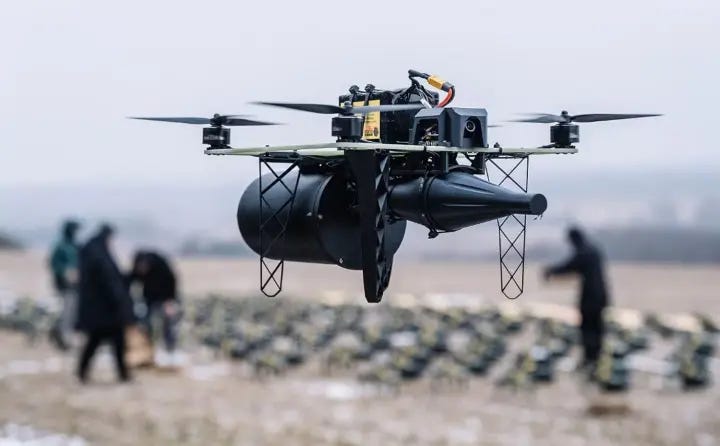
Fiber Optic drones have become significant on the battlefield in Ukraine. The Russians were first to use them. These drones are of the First Person view (FPV) type, meaning that the drone streams live video from an onboard camera on the drone directly to the remote pilot’s view-goggles. Most drone of this type are tactical and short range, typically battery powered, mainly quadcopters (four electric motors), sometimes more (six or eight motors). Until the advent of Fiber Optic drones, the drones communicated using digital radio. Such drones can be used for surveillance and target acquisition or as suicide drones with explosive devices configured for antipersonnel kills or for attacking hardened targets, especially armored vehicles (including tanks), trucks, artillery pieces, radars, command centers and other targets. FPV drones have been used in the tens of thousands and have caused major changes on the battlefield. Shooting down or blocking drones is a major challenge.
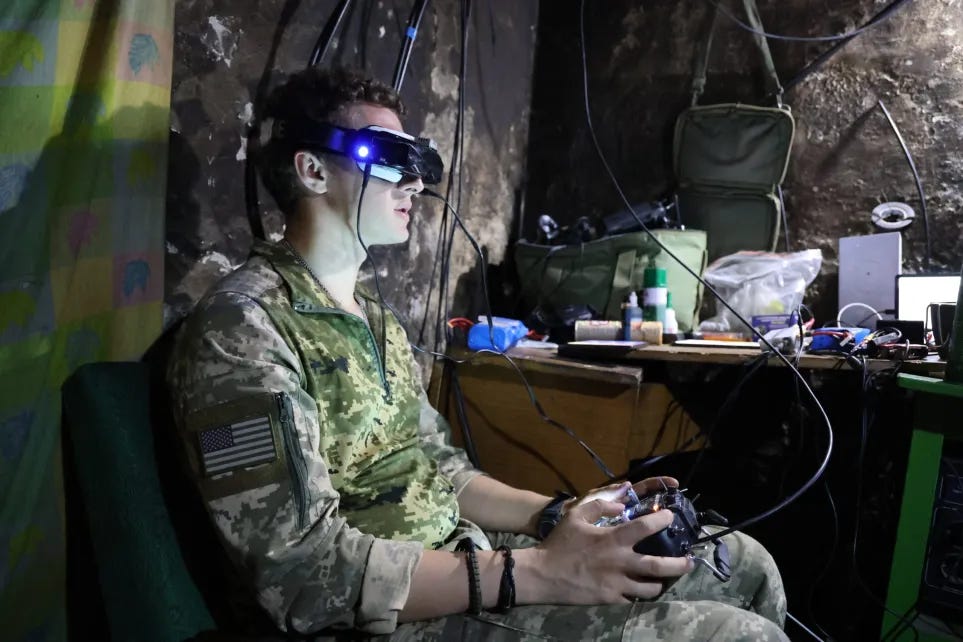
There have been various ways to try and interdict FPV drones, but perhaps the most effective have been RF (Radio Frequency) jammers. Jammers can kill the signal from the drone to the drone operator, so the pilot cannot see the target and the drone’s flight control system can be confused, forcing the drone to crash. RF jamming is not foolproof. Drone transceivers and modems have been engineered to resist jammers, or to switch to alternative frequencies, or use nearby relay drones. A significant drawback of jamming is that friendly RF signals may also be blocked, impacting the use of friendly drones and other RF-based communications.
Fiber Optic drones are 100% jam resistant since they do not use RF signals. Nor do they need GPS (global positioning) because FPV drones are short range and a good pilot with a map overlay can find his way to the battle area or the drone can be called in from the field using map coordinates.
The other feature of a Fiber Optic drone is much enhanced image quality. An RF drone can typically send an image with a resolution of 720p, which is decent as the drone approaches close to its target but poor at distance from the target. RF drones also introduce compression in the video signal, which can degrade the image. In addition, with swarms of drones the RF signal has to share available bandwidth with other drones, that can degrade the signal and introduce delays. A single RF FPV drone will have a lag in the signal of between 30 to 100 ms. (milliseconds), but when it operates in conjunction with others the delay is greater. A Fiber Optic drone, by contrast, has a much higher bandwidth, typically in the 4K or 8K range and a lag of less than 1 ms. There is no interference with other drones because the drone is physically connected to the operator. Speed of communication is around 1 gigabyte.
There are a number of US companies who manufacture Fiber Optic components, but the top ones are controlled under the US ITAR (International Traffic in Arms Regulations) export controls, meaning that individual licenses are required and exports are reviewed by the US State Department and consulting agencies (War Department, Intelligence Agencies, Department of Commerce). Consequently, Fiber Optic reels and associated electronics often are supplied by China and are widely available without restriction. One of the main Chinese providers is Shenzhen Jingwei Technology, although their products are often rebranded. Even so, the Chinese parts are far less expensive than comparable American items, and perform well enough for FPV battlefield drones, and acquiring them is easier and faster.
Fiber Optic fiber reels that automatically dispense the fiber cable are available in different lengths. Obviously the more fiber needed, the heavier the package. Some fiber reel dispensers are said to go up to 50km (31 miles), but the more typical ones on the battlefield are in the 20km (12.4 miles) range.
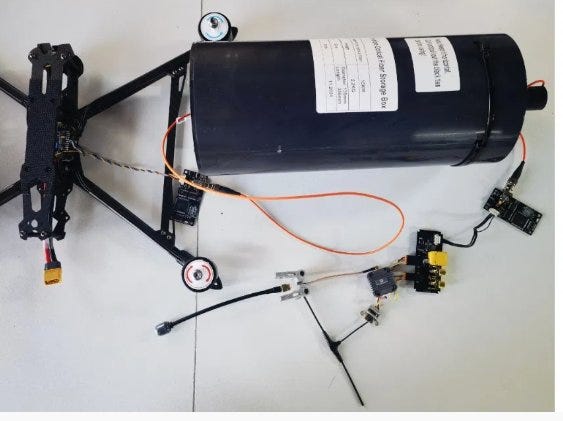
The Russian drone copied by the Czechs for Ukraine is the KVN (Prince Vandal Novgorosky) four engine quadcopter Fiber Optic drone with a claimed range of 65 km (40.3), but realistically less. It is produced by the Novgorod Scientific Production Center (Ushkuynik) at multiple locations.
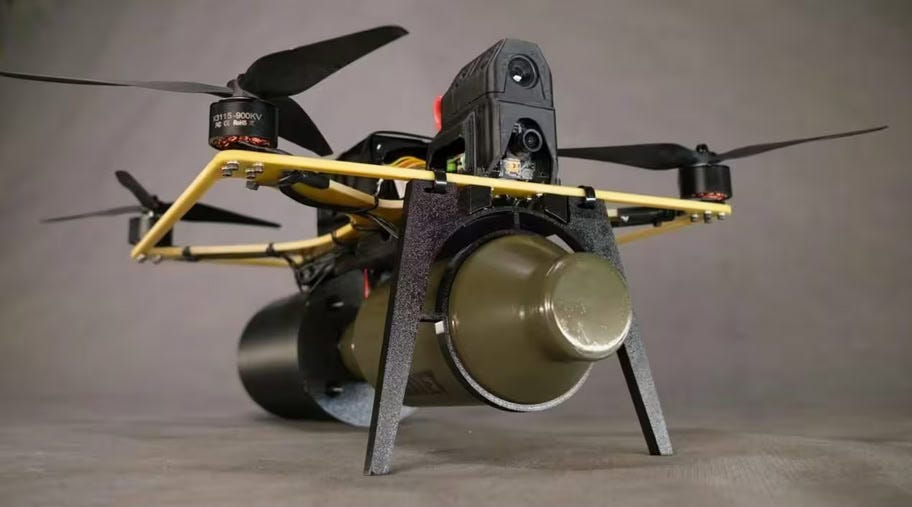
The Czech version is produced by Czech volunteers and companies, notably SPARK. The Czech model is nicknamed nicknamed “Jan Žižka,” a 15th-century Czech general, Hussite leader, and military innovator from Trocnov, Bohemia . The nickname translated means “John One-Eye.” Drones usually have one camera.

The Czechs claim they make the key parts, the airframe, electronics and fiber spools. While it is likely the airframes are 3D printed, the other claims may not be entirely accurate and the presence of Chinese parts is almost certain.
The financing for the Czech drones comes from the “Gift for Putin” (Dárek pro Putina) project, which is a high-profile Czech crowdfunding initiative launched in May 2022 to provide military equipment and humanitarian aid to Ukraine. To date the Czechs and Slovaks have raised $27.5 million through crowdfunding, the latest tranche of $6 million in 2026 to buy generators for Ukraine. As for drones, around 200 have been produced so far.
Spark (Spark spolek, or Spark Association) is a volunteer organization and manufacturing collective that has gained international attention for its “reverse-engineering” approach to military technology.
Ukraine says it now has some 15 manufacturing centers for Fiber Optic drones. Most of these are probably small shops, but they seem able to supply the Ukrainian army with a significant number of drones on a timely basis, although recently there have been complaints of shortages.
Neither the Russian, Ukrainian or even the Czech suppliers would be in business without China. Officially China says it does not supply combat drones, but this is clearly misleading.
China supplies 80 to 90% of the world’s commercial drones and 70 to 90% of drone parts. China dominates global commerce in rare earth magnets (vital for electric drone motors), lithium batteries and drone electronics. Most of the cameras for drones are made by the Chinese drone maker, DJI. Observers speak of the Shenzhen Cluster in China where one can find all the elements needed for drone manufacturing.
Even the US can’t block Chinese-made lithium batteries, motors and cameras for drones, and US export and import controls, even those of the US War Department, have special regulatory loopholes so Chinese parts can be purchased and continue to proliferate in US military small drone production. The Pentagon says it won’t use Chinese electronics, but otherwise it will approve motors, batteries, maybe cameras.
The same applies elsewhere. Until the US overcomes the rare earth bottleneck (needed for magnets and batteries, for example), the only source for critical drone supplies is China.
Even so, the Czech voluntary approach demonstrates that where there is a will, there is a way.
I struggle to get my head around 65km spools with latency below 1ms.
But clearly they exist and work at 100kph and are only about 20x30cm spooled, weighing only a couple of kilos.
And I've seen images of frontline areas covered with a mesh of near-transparent kevlar-reinforced 150u fibres, like a vast spiderweb.
I guess eventually that complicates not only target approach of further drones, but various other things too?
It's a strange new frontline (if that word means much any more) in many ways, transformed by drones as earlier by longbows or guns.
War will never be the same again.
Excellent breakdown on how fiber optic dispensers solve the jamming problem. The shift from 30-100ms lag in RF drones to sub-1ms in fiber variants is huge for precision targeting. Also interesting how China's dominance in rare earths and components basically makes them the quiet supplier for both sides regardless of export controls.