
REPORT ON IRANIAN NAVY SITUATION (MARCH 4, 2026)
Much of Iran's Navy Neutralized

There is an old joke. Why does the Italian Navy have glass bottomed boats? Answer, so they can see the previous Italian Navy.
It is looking like the joke can be rewritten, although it will be some time before Iran has glass bottomed boats.
Here is the latest:
Iran’s Navy and IRGC Naval Ships Confirmed or Reported Damaged (March 2026)
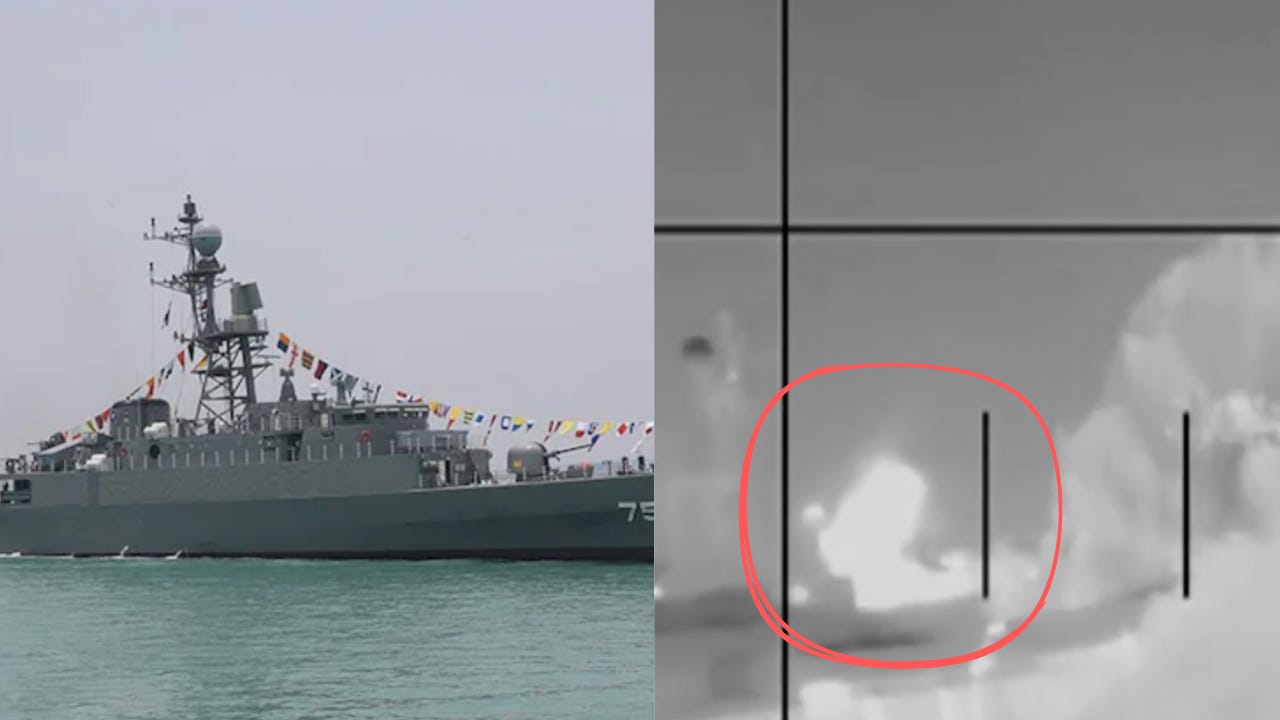
IRIS Dana was sunk today by a US submarine near Sri Lanka. A single Mark 48 torpedo (probably ADCAP version) destroyed the ship, confirmed by War Secretary Pete Hegseth. IRIS Dena 75 was a Moudge-class corvette in the Southern Fleet of the Islamic Republic of Iran Navy, named after Mount Dena. The Sri Lanka navy is picking up survivors. Number of casualties uncertain. Crew size was around 140.
Other ships:
Shahid Sayyad Shirazi (FS313-03): This ship was widely reported and filmed on fire near the port of Bandar Abbas on March 4, 2026. Satellite imagery and social media footage confirmed the vessel was engulfed in smoke following U.S. and allied strikes.
Shahid Soleimani (Lead Ship): While specific damage reports for the lead ship are less detailed than the Shirazi. Pete Hegseth mentioned destroying this ship in this morning’s press conference (March 4, 2026)
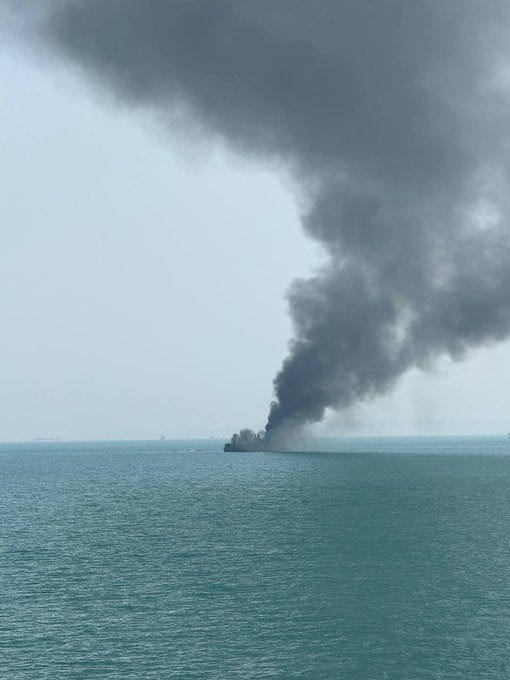
Iranian Navy Shahid Soleimani-class corvette, Shahid Sayyad Shirazi, was seen on fire near the port of Bandar Abbas after U.S. strikes. Shahid Hassan Bagheri: Similar to the lead ship, this vessel is part of the fleet stationed at Bandar Abbas, which has seen extensive strikes.
During this same period, other major Iranian naval assets have been confirmed sunk or severely damaged:
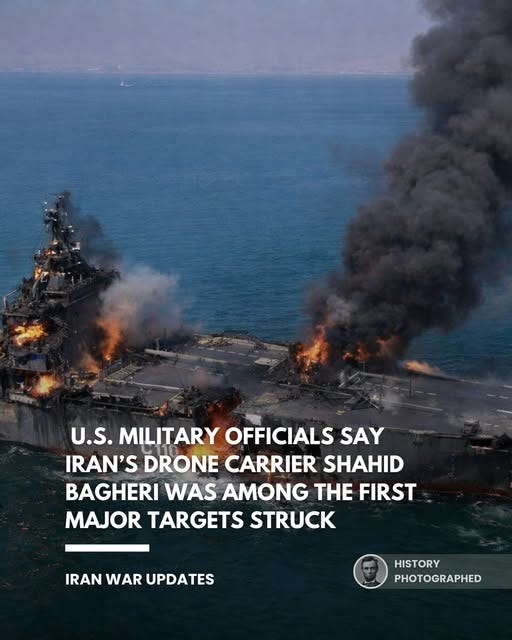
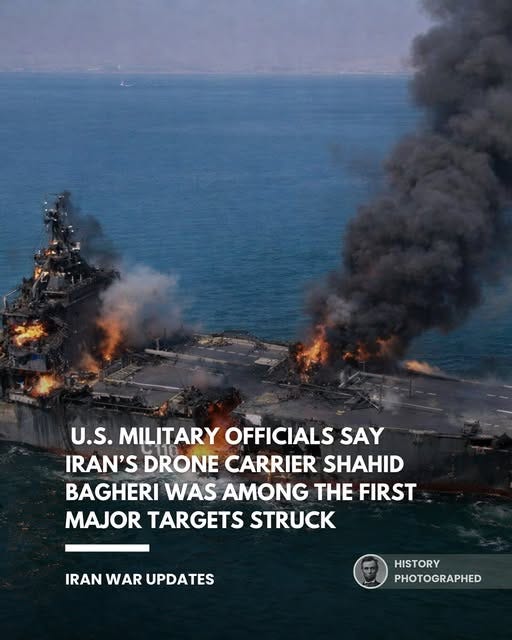
Shahid Bagheri (Drone Carrier): Confirmed hit and severely damaged/sunk within the first hours of the operation.
Jamaran-class Corvette: At least one vessel of this class was confirmed by CENTCOM to be “sinking to the bottom of the Gulf of Oman” at the Chahbahar pier on March 1, 2026.
IRINS Makran (Forward Base Ship): Satellite imagery from March 2 shows the Makran (a massive converted tanker used as a mobile base) on fire at its berth in Bandar Abbas.
This is only a partial list.
The Pentagon says a total of 20 Iranian Navy and IRGC ships have been damaged or destroyed so far.
These numbers don’t count small craft armed with missiles and guns that are run by the IRGC.
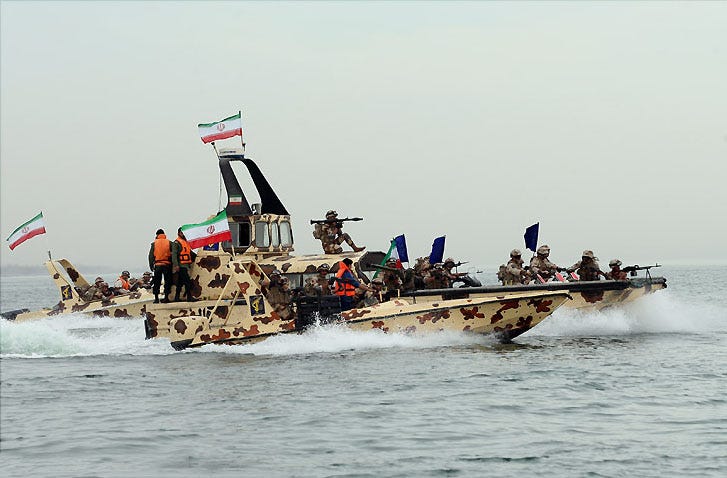
Admiral Cooper stated that “hundreds” of small-craft targets—the backbone of the IRGC’s asymmetric naval strategy—have been hit at their moorings in Bandar Abbas, Bushehr, and Assaluyeh.
Iranian Submarines
Admiral Cooper confirmed that Iran’s most capable submarine—identified by analysts as a Fateh-class coastal submarine—now “has a hole in its side” and is no longer operational. This vessel was reportedly struck near Bandar Abbas.
Midget Submarine Fleet: While an exact count was not provided, CENTCOM reported that “midget subs” (likely the Ghadir-class) were among the 17 naval vessels confirmed as destroyed or sunk during the initial 100 hours of Operation Epic Fury.
Kilo-class (Russian diesel-electric subs): U.S. officials confirmed that heavy strikes involving B-2 stealth bombers and Tomahawk missiles targeted the submarine pens at Bandar Abbas. While specific damage to the three Russian-built Kilo-class boats (Taregh, Nooh, and Yunes) is still being assessed via satellite imagery, they are currently considered trapped or inoperable due to the destruction of their support infrastructure
So far, the US and Israel have destroyed the known TEL sites, but none of the hidden ones, and Iran is a major player.
The military technical term for this is time-sensitive targeting (TST) of launcher-erector-carriers (TELs).
It is the most physically demanding task in modern warfare.
During the 1991 Gulf War, the United States enjoyed total air superiority and spent weeks trying to destroy Saddam Hussein's mobile Scud missile launchers.
The coalition conducted approximately 2,500 sorties specifically aimed at tracking Iraqi mobile Scud launchers in western Iraq.
Flat desert terrain, total air supremacy, world-leading ISR capabilities.
The post-war consensus, confirmed by numerous classified and unclassified analyses, is that the coalition likely never destroyed a single operational mobile launcher.
Every claimed “victim” turned out to be a decoy, a truck, or an empty launcher.
Scud missiles continued to be fired until the ceasefire.
Iran has had 35 years to learn this lesson.
Their mobile launch force is dispersed across a country three times the size of Iraq, with far more complex terrain: the Zagros Mountains, urban areas with over 80 million inhabitants, and tunnel networks whose entrances can be identified by satellite imagery, but whose interiors are undetectable.
Iranian road-based mobile launchers can be concealed in ordinary garages, warehouses, under highway overpasses, and inside mountain tunnels.
They can move, climb, shoot and relocate in less than 15 minutes.
The Iranian navy is taking a hammering, and will probably end up being eliminated.
It stood little chance of being of any use anyway, as the US fleet wisely keeps it's distance from Iran and it's various anti-ship missiles.
At the same time, the US is hammering the Iranian navy, mostly because they can, and because most of the ships are sitting (moored) ducks, perfect targets for stand-off weapons - A fast and safe way to rake up some impressive numbers to dazzle the audience at home.
Let's see what the next weeks will bring. USA & Israel decided to start this war, but Iran will surely have a say in when to end it.